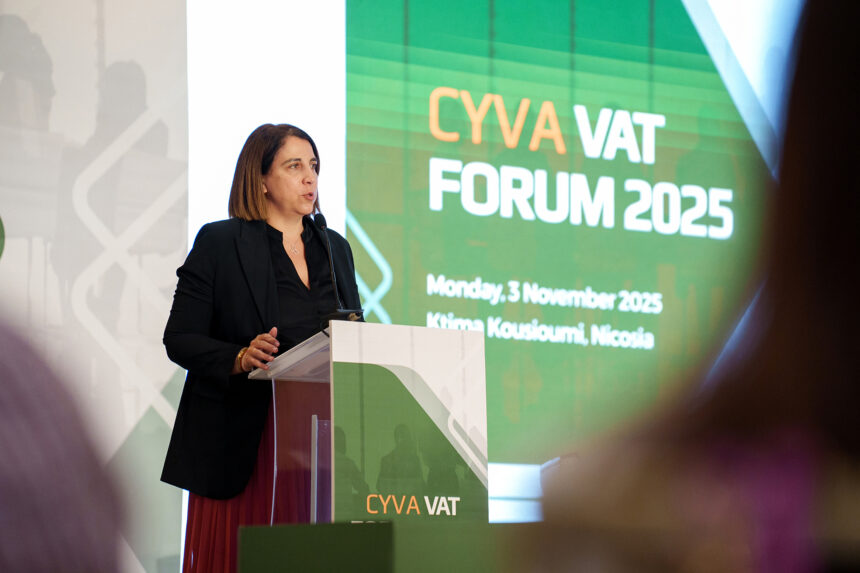
VAT is the cornerstone of Cyprus’ public revenue system, as highlighted by Deputy Minister to the President, Irene Piki, during her address at the CYVA VAT Forum 2025. The event took place on Monday, 3 November 2025, at Ktima Kousioumi in Nicosia, gathering nearly 200 delegates to discuss the significance of Value Added Tax (VAT) both in Cyprus and globally.

Photo: in-cyprus.philenews.com
Significant Contributions to National Budget
In her opening remarks, Piki revealed that in 2024, VAT contributed €2.8 billion, representing 38% of the total income for the Republic of Cyprus. This figure marks a 6.8% increase from 2023 and an impressive 25.8% rise compared to 2022. Such substantial contributions underscore the vital role of VAT in the nation’s fiscal framework.

Photo: in-cyprus.philenews.com
The Universal Impact of VAT
Piki emphasised that “VAT affects every citizen and every business,” indicating its pervasive influence across various sectors. She noted that the effectiveness of the VAT system in Cyprus is closely linked to broader public sector reforms and strategic policies aimed at enhancing governance.
Future Tax Reforms on the Horizon
Looking ahead, Piki mentioned the government’s plans for a tax reform initiative designed to promote a fairer redistribution of wealth. The aim is to simplify tax processes, increase transparency, and bolster business competitiveness. These changes are part of a comprehensive strategy to modernise the tax landscape in Cyprus.
Role of CYVA in Shaping VAT Practices
The Cyprus VAT Association (CYVA) plays a pivotal role in developing a modern and effective tax system. The organisation serves as a bridge between policymakers and practitioners, helping translate complex VAT legislation into practical solutions that benefit both the public interest and the business community.
Expert Insights at the Forum
The forum featured a distinguished panel of experts from both Cyprus and the EU, including Dr. Savvas Papasavvas, Cypriot Vice-President of the General Court of the EU, and Prof. Dr. David Hummel, Référendaire at the Court of Justice of the EU. Their contributions highlighted current VAT challenges and shared insights into best practices and future developments in the field.
Updates from the Cyprus Tax Department
Delegates were also informed about the progress of the Integrated Tax Administration System (Tax For All – TFA) by a team from the Cyprus Tax Department. The initiative aims to streamline tax processes, enhancing efficiency and compliance for businesses.
A Personal Touch from VAT Experts
Alexis Tsielepis, Vice-Chairman of CYVA and a noted VAT expert, shared his personal journey in the field, humourously referring to himself as a ‘VATaholic’. Such anecdotes brought a relatable element to the discussions, engaging the audience while shedding light on the complexities of VAT advisory work.
Addressing Current VAT Challenges
The forum’s high-level panel tackled pressing issues that currently affect VAT, offering insights into how these challenges can be met. Topics covered included compliance, international VAT trends, and the impacts of digitalisation on tax collection.
Gratitude and Acknowledgements
The event concluded with remarks from CYVA Chairwoman, Demetra Constantinou, who expressed her gratitude to the attendees for their participation. The forum was supported by several sponsors, including Bakertilly Klitou and Partners, Chelco VAT Ltd, and Costas Tsielepis & Co Ltd, among others.
A Unified Voice for VAT Professionals
Founded in 2019, CYVA aims to provide a unified and independent voice for VAT professionals and businesses in Cyprus, advocating for fair and effective VAT practices. The organisation continues to play a crucial role in fostering dialogue and collaboration among stakeholders in the VAT community.