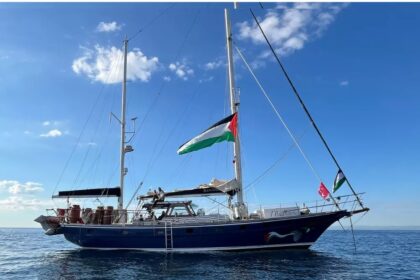
german activists — German activists were allegedly detained and expelled by Cypriot authorities while attempting to deliver humanitarian aid to Gaza. The incident occurred on 12 September when four activists were intercepted near Coral Bay in Paphos, prompting their vessel to divert to Turkey.
German activists: Detention and Interception Details
The activists, reportedly carrying medical supplies and food intended for the people of Gaza, faced questioning about their documentation by Cypriot officials. According to the Italian news outlet Il Manifesto, they were intercepted by authorities who expressed doubts about their German citizenship documents.
Alex, a Berlin-based activist with Ecuadorian roots, recounted their experience. “I was born in Ecuador but have German citizenship. For the police, however, my documents weren’t in order,” he stated, emphasising the challenges they faced despite holding valid documentation.
Authority’s Actions and Vessel Documentation
The port police in Cyprus raised concerns about the vessel’s documentation, despite it being legally purchased for the specific mission to Gaza. Alex revealed that authorities initially boarded the vessel without permission before the captain allowed a search. They attempted to confiscate medical supplies but ultimately retreated due to a lack of legal grounds to proceed.
Despite these challenges, the activists remained determined to fulfill their mission of humanitarian support. The authorities issued a directive for the group to divert their vessel away from Gaza, stating, “Tomorrow morning we will escort you 12 nautical miles from the coast to ensure you don’t head towards Gaza. Then you’ll go west, away from Cyprus. Agreed?” This firm stance left the activists feeling threatened and uncertain about their next steps.
Release Under Strict Conditions
After being held overnight under seizure orders, the activists were released on 13 September. However, they faced strict conditions that prohibited any approach towards Gaza. Alex described the tense atmosphere during their detention, stating, “We were surrounded by many agents. We have no idea who they were or why they wouldn’t let us sail.” The authorities made it clear that any attempt to head towards Gaza would lead to arrest.
Furthermore, the activists were instructed to refuel and gather provisions before departing from Cyprus immediately. This abrupt change in plans forced them to redirect their humanitarian mission to Turkey instead of Gaza, where they had originally intended to deliver aid.
Change of Plans and Journey to Turkey
The activists had initially planned to remain in Cyprus for several days to address technical issues and facilitate crew changes before proceeding as part of the broader Global Sumud Flotilla initiative. However, the unexpected turn of events left them no choice but to adapt to the new circumstances.
Following their release, the vessel successfully reached Alanya, Turkey, after the activists leveraged social media to seek a safe harbour. Their journey from Germany had begun with the intent to provide essential supplies to those in need in Gaza, but they now faced the reality of a diverted mission.
Humanitarian Mission Amidst Challenges
The activists, who had departed from Germany and made their way through Rhodes, were motivated by a commitment to support the Gaza community during a time of need. Their efforts reflect a broader movement of activists seeking to provide humanitarian aid in conflict zones, often facing significant obstacles.
The actions taken by Cypriot authorities raise questions about the treatment of humanitarian missions and the legal frameworks governing such operations in international waters. The activists had expected cooperation rather than confrontation, reflecting the complexities of delivering aid in politically sensitive regions.
Community and International Reaction
The events have sparked discussions among various humanitarian organisations and observers regarding the challenges faced by aid workers in conflict areas. While Cyprus has not publicly commented on the incident, the actions of its coast guard have drawn attention to the precarious nature of humanitarian aid delivery.
As the activists regroup in Turkey, they remain committed to their cause, seeking alternative ways to deliver assistance to Gaza. Their experience serves as a testament to the difficulties faced by those attempting to provide support in regions affected by conflict.