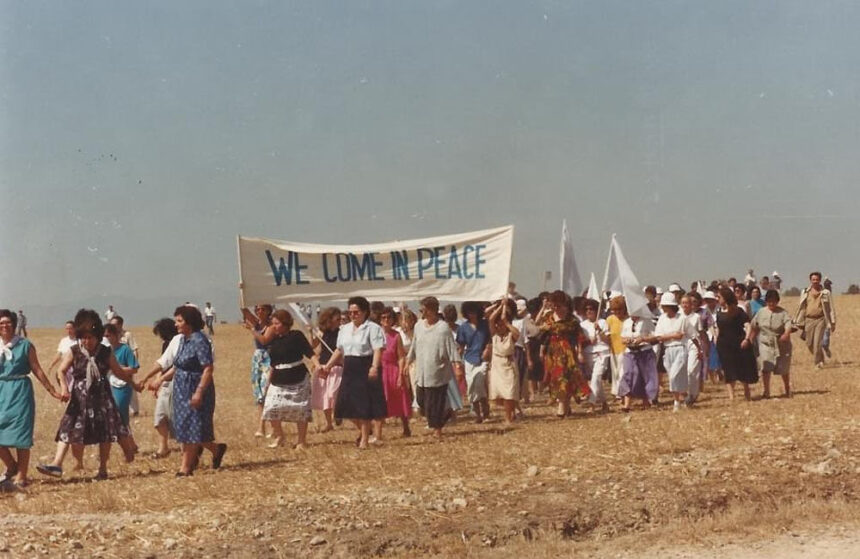
The Women Walk Home movement emerged as a powerful statement of peace and resilience in Cyprus during the 1980s, following the profound impact of the 1974 Turkish invasion. On April 20, 1975, thousands of Greek Cypriot women, many displaced by the conflict, marched towards Famagusta, stopping at the Derynia checkpoint. With a banner that read “We Come in Peace,” they were joined by women from around the world, creating a poignant image as they silently walked in the rain towards the buffer zone.

Photo: in-cyprus.philenews.com
This initial march, involving an estimated 30,000 participants, set the stage for what would become a series of demonstrations known as the “Women Return” marches. It would take over a decade for the momentum of this movement to be rekindled.
In 1987, some of the original organisers of the 1975 demonstration reformed the Women Walk Home movement. They sought to act independently of political affiliations and stressed the importance of peaceful protest. Their goal was to cross the buffer zone into the areas occupied by Turkish forces. Despite opposition from both the Cypriot and Greek governments, which labelled the march as harmful, support from political parties, trade unions, and other associations bolstered their resolve.
On June 18, 1987, approximately three hundred women set off from Aglantzia and marched towards the hill of Aronas, where they were stopped by UN peacekeepers. Later that year, in November, another march attracted around a thousand participants who successfully bypassed UN forces and entered the occupied areas. This time, the marchers encountered Turkish soldiers, and the event garnered significant media attention amid Cyprus’s presidential electoral campaign.
The movement’s resolve continued to shine through when, on June 13, 1988, they staged a symbolic protest at the Acropolis in Athens during the visit of Turkish Prime Minister Turgut Özal. One hundred women unfurled an 18-metre banner proclaiming “No to Occupation.” Following their forceful removal by Greek police, the participants regrouped at the Parthenon to reaffirm their commitment to Cyprus’s freedom.
March 19, 1989, marked another significant date for the Women Walk Home movement, with two demonstrations taking place simultaneously in Lympia and Achna. In Lympia, women carrying white flags attempted to reach the chapel of the Holy Cross located within occupied areas but were met with violence from Turkish soldiers. In Achna, marchers entered the ruined village and sang hymns in the church of Agia Marina. Although over 50 participants were detained, they were released the following day.
This was the last major demonstration orchestrated by the Women Walk Home movement. By this time, internal divisions had surfaced among the leadership, stemming from differing views on bi-communalism and the movement’s objectives. This discord led to the formation of a new group called “Return,” which organised what would be the last anti-occupation march on July 19, 1989.
During this event, women entered the buffer zone at Ayios Kassianos, carrying Greek flags and accompanied by church officials. They bypassed UN peacekeepers, entering both the Ayios Kassianos elementary school and the Ayios Georgios chapel. The Turkish army responded with brutality, detaining over a hundred participants for up to ten days. In reaction to the extended detainment, a sit-in protest was organised by the Return initiative at the buffer zone near Nicosia airport, drawing widespread support from Greek Cypriot society.
Post-1974, Greek Cypriot women were often portrayed in the media as symbols of loss and suffering, depicted as grieving mothers and refugees deprived of their homes. However, the Women Walk Home movement transformed this narrative, showcasing these women as active political participants rather than passive victims. Organised independently of political parties, their marches highlighted the agency of Greek Cypriot women, asserting their presence in a political landscape largely dominated by state interests since the conflict.