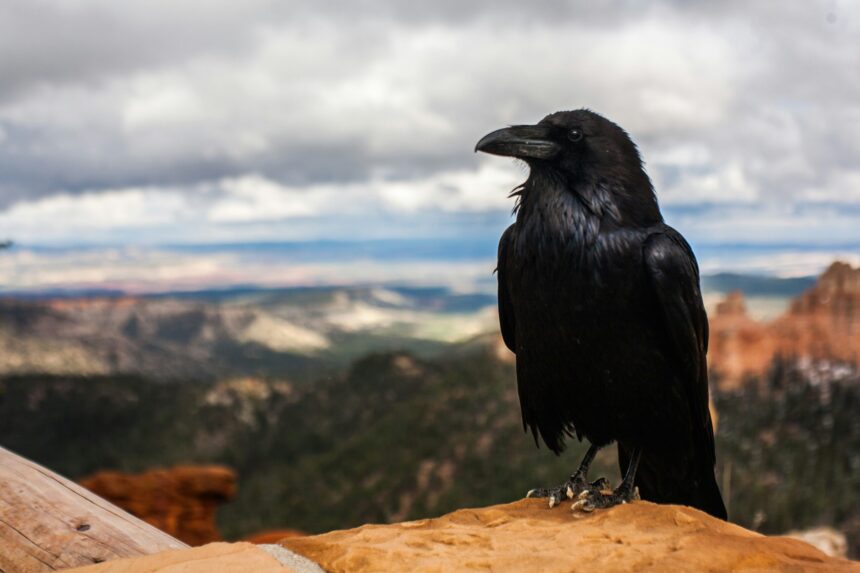
cyprus crows — Cyprus crows are smarter than you think, showing remarkable intelligence that challenges our traditional notions of avian behaviour. Over the past year, I’ve spent time feeding the neighbourhood crows, and what began as a simple routine quickly transformed into a fascinating study of their behaviours and capabilities. These birds learned to respond to a whistle, anticipated feeding times, and even recognised me from different windows around the house. Their cleverness was apparent as they stole cat food and confidently scared away pigeons, prompting me to reflect on how much more aware these creatures are than many people realise.

Photo: cyprus-mail.com
Often viewed as mere noisy scavengers, crows have gained a reputation in scientific circles as some of the most intelligent animals on the planet. With problem-solving skills, the ability to remember individual humans, and a capacity for social learning, these birds exhibit behaviours once thought to be unique to humans and other primates.

Photo: cyprus-mail.com
Cyprus crows: Understanding the Corvid Family
Cyprus is home to various species within the corvid family, including the well-known Hooded Crow, Eurasian Magpies, Jackdaws, and the endemic Cyprus Jay, which is found in the Troodos, Paphos, and Machairas forests. Elena Markitani, Communication Coordinator at BirdLife Cyprus, underscores the importance of including corvids in discussions about intelligence in the animal kingdom. According to her, “Corvids absolutely deserve to be part of that conversation because their intelligence has been repeatedly demonstrated through observation and experiments.”
The Unique Brains of Crows
What makes corvids so intriguing is their ability to demonstrate complex behaviours despite having a brain structure that differs significantly from mammals. Markitani explains, “When we see corvids showing behaviours that look ‘ape-like’—tool use, planning, social learning, memory—it tells us that advanced intelligence can evolve in very different branches of the animal kingdom.”

Photo: cyprus-mail.com
Recognition and Communication Skills
Recent research has shed light on the astonishing capabilities of crows. They can recognise human faces and associate specific individuals with danger, effectively communicating this information to other crows. Markitani notes, “A crow is not simply reacting to a human; it can distinguish one person from another and adjust its behaviour based on past experience. That kind of ability is highly valuable for survival, especially in environments shared with people.”
Scientists from the University of Tübingen have revealed that carrion crows can produce various sounds based on numerical cues, drawing parallels to how toddlers learn to count. Additionally, studies have shown that these intelligent birds can create tools, plan for future needs, and understand recursive patterns, which were once thought to be exclusive to human cognition.
Street Smarts of the Hooded Crow
Closer to home, the Hooded Crow in Cyprus showcases its adaptability and keen observational skills. Frequently seen scavenging for food, these birds are adept at watching human behaviour to exploit opportunities. One particularly impressive behaviour observed in urban areas is their use of traffic to crack open hard-shelled nuts.
Markitani describes how these crows drop nuts onto roads, allowing cars to crack them open, highlighting their opportunistic problem-solving skills. “Yes, crows in Cyprus show many signs of adapting very successfully to human environments and routines,” she adds. They’ve also learned to rummage through garbage cans for food and take advantage of stray animals’ feeding times.
Learning from Human Habits
These seemingly ordinary behaviours reveal a wealth of intelligence. They demonstrate learning, memory, flexibility, and the ability to connect human routines with food sources. Markitani points out that humans often exhibit predictable patterns in behaviour, which crows have adeptly learned to navigate. “They are omnivorous, intelligent, and socially aware,” she states. “A bird that is observant, cautious, opportunistic and able to learn can do very well in such places.”
Expanding Our Understanding of Intelligence
The research surrounding crows is shifting perspectives on what constitutes intelligence in the animal kingdom. “They teach us that intelligence has evolved more than once, in different forms and under different pressures,” says Markitani. Corvids challenge the dated notion that complex cognition is primarily a trait of mammals with large brains. By studying corvids, scientists hope to better understand the evolution of intelligence and the environmental pressures that favour problem-solving abilities.
The Ecological Role of Crows
Beyond their intelligence, crows play a vital role in Cyprus’s ecosystems. As scavengers, they help eliminate carrion and organic waste, while jays contribute to seed dispersal and woodland regeneration. Although corvids can sometimes conflict with farmers by preying on eggs, it’s crucial to appreciate their ecological functions rather than merely labelling them pests. Markitani reminds us, “Their impact is not one-dimensional; they can create costs in some situations, but they also provide ecological services such as scavenging and nutrient recycling.”
So, the next time you encounter a crow in the city or countryside, remember they are not just common black and grey birds. They are among the most intelligent avians on Earth, offering us a daily reminder that remarkable wildlife exists even in our most familiar surroundings.