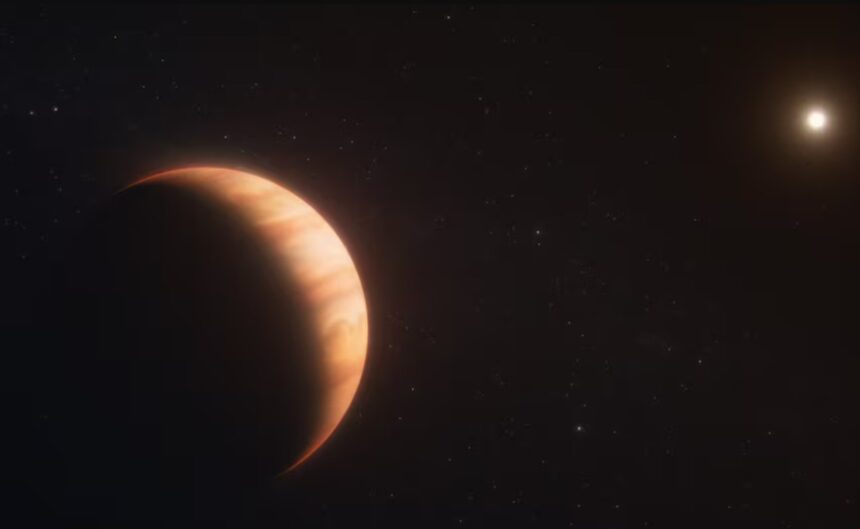
Exoplanet WD 1856 b has intrigued astronomers as it continues to exist billions of years after the death of its sun-like star. Located 81 light-years from Earth in the constellation Draco, this gas planet is an extraordinary example of planetary survival in the universe. As our sun approaches its eventual demise in about 5 billion years, the fate of its planets remains uncertain, making the study of WD 1856 b particularly relevant.
Remarkable Features of WD 1856 b
WD 1856 b is a gas giant with a mass approximately eight times that of Jupiter, our solar system’s largest planet. Researchers have found its atmospheric temperature to be about 260 degrees Fahrenheit (127 degrees Celsius), which is unusually warm for a planet in its position.
This exoplanet orbits very closely to a white dwarf, the remnant of its host star, residing 50 times closer to this stellar remnant than Earth is to the sun. WD 1856 b completes an orbit in just 1.4 days, highlighting a unique gravitational relationship with the white dwarf.
The Journey to Its Current Orbit
The dynamics that WD 1856 b experiences offer insights into how some planets can persist after the death of their host stars. Unlike the planets in our solar system, which face a different fate when the sun eventually becomes a white dwarf, WD 1856 b exists in a complex gravitational environment. The white dwarf is part of a triple star system, accompanied by two red dwarf stars, each roughly 30 per cent of the sun’s mass.
Astrophysicist Christopher O’Connor of Northwestern University, one of the study’s authors, commented on the planet’s unusual orbit, stating, “There are two main competing ideas for how WD 1856 b got into the tight orbit we observe today.”
- One theory suggests that during the star’s red giant phase, WD 1856 b was engulfed but managed to survive just outside the stellar core that became the white dwarf.
- The alternative theory posits that the planet was originally far enough from the star to avoid engulfment, but later gravitational interactions with the nearby red dwarfs pushed it into its current orbit.
Understanding WD 1856 b’s Composition
The original discovery of WD 1856 b in 2020 provided the first definitive evidence that planets could survive after a sun-like star’s death. The recent study, utilising the advanced capabilities of the James Webb Space Telescope, offers deeper insights into its composition and history.
WD 1856 b is primarily composed of hydrogen and helium, akin to Jupiter, yet it possesses an unusually high concentration of methane. Researchers attribute its elevated atmospheric temperature to interactions with the strong gravitational forces of the white dwarf, as its orbit has gradually migrated closer over time.
Comparative Size and Mass
While stars are typically much larger than their planets—the sun is about 1,000 times bigger in volume than Jupiter—WD 1856 b presents a different scale. It is about 500 times larger than the white dwarf, which is only slightly larger than Earth. Although the white dwarf formed from a star up to twice the mass of the sun approximately 5 billion years ago, it is extremely compact.
The Future of Our Solar System
The fate of our solar system as the sun transitions into its red giant phase raises numerous questions. During this transformation, the sun will expand to nearly 200 times its current size, likely consuming the innermost planets, Mercury and Venus.
O’Connor remarked on the expected impact on other planets, stating, “The rest of the planets beyond Earth will be well beyond the sun’s maximum size, so they will most likely just continue to orbit the white dwarf left behind by the sun.” He further noted that, as the sun loses about half of its mass during this process, the surviving planets will gradually drift away, potentially reaching double their current orbital distances.
Uncertainty remains regarding Earth’s fate. O’Connor explained, “We cannot predict Earth’s future orbit well enough to know whether it will be inside or outside the ‘danger zone’ when the sun reaches the end of its life. Fortunately, this is one problem we still have billions of years to figure out.”
Implications for Exoplanet Research
The study of WD 1856 b not only enhances our understanding of planetary survival but also contributes to the broader field of exoplanet research. As scientists continue to explore planets beyond our solar system, the insights gained from WD 1856 b could inform models of planetary dynamics and stability in extreme environments.
Such research may ultimately shed light on the potential for life in similar conditions elsewhere in the universe, raising important questions about the resilience of planetary systems in the face of stellar evolution.