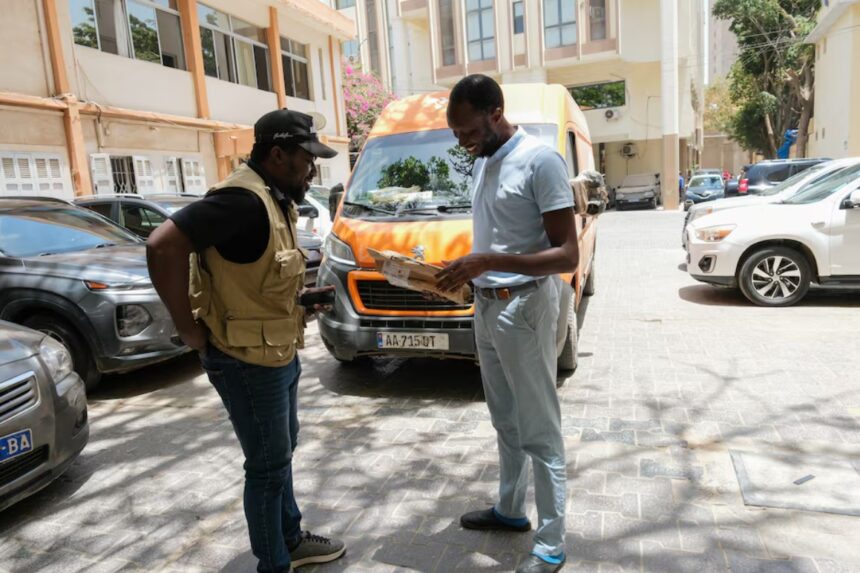
Package-forwarding firms are transforming the way African online shoppers access international brands like Amazon and Walmart, despite the continent’s limited banking infrastructure and delivery challenges. As internet penetration increases, these companies are leveraging technology to facilitate online purchases for consumers who lack formal street addresses or traditional bank accounts.
Package-forwarding firms: Bridging the Gap for Consumers
One such company is Afrety, a Senegalese startup that has emerged as a key player in this evolving landscape. Established in 2018, Afrety allows customers to use delivery addresses at warehouses located in France, the United States, and China. This enables shoppers to consolidate multiple purchases and have them dispatched to West Africa, helping to streamline the process.
Innovative Payment Solutions
For those without bank cards, Afrety offers the option to pay through digital and mobile money accounts, which can be topped up with cash at local kiosks. This payment model is especially prevalent in Senegal and other areas of Africa, where mobile money services have gained traction as a reliable alternative to conventional banking.
Efficient Delivery Systems
Once packages arrive in Senegal, Afrety employs motorbikes and vans equipped with GPS to deliver orders throughout major cities like Dakar. Souane Diop, the 34-year-old CEO of Afrety, emphasised the importance of flexibility in their operations, stating, “You have to be very, very, very flexible. That’s the key word.” The company has seen significant growth, now handling around four to five metric tons of air shipments and two to three containers by sea each week.
Competition in the Package-Forwarding Market
While Afrety is making strides, it faces competition from larger global logistics firms like Aramex. This company operates two platforms—MyUS and Shop and Ship—that cater to the African market. Aramex, which acquired MyUS in 2022, aims to provide African consumers with access to a multitude of brands that are otherwise unavailable. Amadou Diallo, CEO of Aramex Group, noted that Sub-Saharan Africa is one of the fastest-growing regions for their services.
Challenges in Expanding E-Commerce
Despite the growth potential, both Afrety and Aramex face significant challenges. E-commerce in Africa is largely concentrated in major cities, where wealth is more prevalent. According to Tech Cabal Insights, only around 43 per cent of Africans have internet access, and even fewer possess the disposable income to shop online. In Nigeria, a key economic player, only one in three internet users engages in online shopping, while the situation is even more dire in Central Africa, where only one in twenty people shop online.
The South African Exception
South Africa stands out as an exception on the continent, boasting the highest levels of internet usage and online shopping. Mastercard estimates that online retail volumes in South Africa will grow by nearly 35 per cent annually over the next five years, reaching approximately 140 billion rand (around $7.26 billion) by 2025. This growth has encouraged major brands to establish their operations in the region, with Amazon launching its first online marketplace in South Africa in 2024 and Walmart opening its first branded stores in Johannesburg last year.
Future Prospects for African E-Commerce
While Amazon and Walmart have not disclosed any plans to expand beyond South Africa, the competition among package-forwarding firms continues to intensify. Jumia, a Nigerian retail company often referred to as the ‘Amazon of Africa,’ operates across eight countries in the region. Although Jumia has yet to achieve profitability, its CEO, Francis Dufay, remains optimistic, stating that the company is focused on tailoring its services to local markets to fend off competition from Chinese retailers like Temu and Shein.
The Nigerian Market’s Untapped Potential
Nigeria is viewed as one of the most promising e-commerce markets in Africa, with estimates suggesting the sector could reach around $75 billion by 2025. In April 2023, Aramex opened a new warehouse in Nigeria, while Jumia reported a 50 per cent growth in its business within the country during the last quarter of 2025. Dufay remarked, “It’s still totally underpenetrated. We’re just at the beginning of our transformation in Nigeria.”