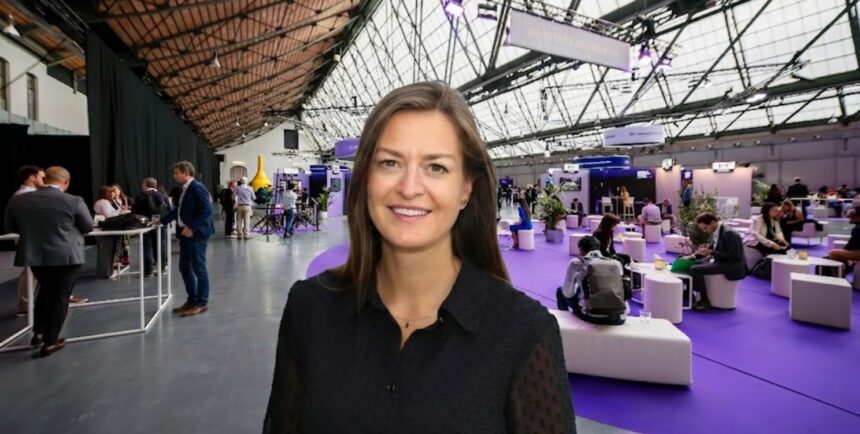
europe startups — europe startups — Eliza Kruczkowska, director of innovation development at the Polish Development Fund, asserts that Europe must overcome fragmentation to scale startups effectively. Speaking at the 2026 European Innovation Council Summit in Brussels, she highlighted the importance of cross-border collaboration to foster innovation and growth among European startups.
Despite notable advancements in supporting entrepreneurship across the continent, Kruczkowska pointed out that Europe still struggles to function as a cohesive innovation space. “It’s always very useful to meet people from all over Europe,” she remarked, emphasising the value of diverse perspectives in addressing common challenges.
Kruczkowska noted that the summit provided a vital platform for stakeholders to collaborate and share insights, particularly as competition from global players intensifies. She reiterated the necessity for deeper European collaboration beyond national interests, reflecting on the persistent barriers posed by internal fragmentation.
Over the past decade, Europe has made significant strides in building institutional frameworks to support startups. However, Kruczkowska cautioned that the challenge now lies in fostering a unified identity and direction. “Lots of good things happen. That was a great wake-up call for us and maybe motivation to be faster,” she explained, referencing the ongoing comparisons with the United States.
She reminisced about the landscape of startup discussions at European policy forums 15 years ago, where the focus was primarily on research and development rather than entrepreneurship. “For the last 15 years, we have really made huge progress, and those institutions on the European level are very crucial because they think above national interest,” she stated.
Yet, she acknowledged the difficulty of convincing national policymakers of the concept of a unified “Team Europe.” Kruczkowska expressed that the core of this challenge is defining what Team Europe truly means and identifying its leadership. “It is very challenging to convince people back home that there is Team Europe,” she said.
In her view, Europe’s global standing should be recognised as an asset rather than a liability. She highlighted the societal balance and quality of life that Europe offers, stating, “When you look at the globe, you really feel that Europe is your home. Europe is a really great place to live. It is a safer place, and we really care about the whole society.”
Addressing the common perception that Europe moves slower than the US, Kruczkowska argued that this difference stems from distinct value systems rather than structural deficiencies. “They can laugh that we are slower because of that, but the question is what is more important in your life?” she asked. “We have in Europe this sense of balance.”
Turning her attention to Poland’s rapid technological advancement, she attributed this progress to targeted public investments and institutional frameworks that have expanded access to venture capital. Kruczkowska pointed to the establishment of the Polish Development Fund as a pivotal moment in supporting early-stage innovation and access to capital. “Ten years ago, we launched a new institution called the Polish Development Fund. It boosted access to capital. Before that, nobody really knew what venture capital was and how to get funding,” she explained.
With this support, Poland has developed a robust ecosystem that aids various stages of business growth, from research and development spin-offs to startups securing significant funding. “We started to educate the market and run tenders for new venture capital funds. Now we are the biggest investor in the region,” she noted.
Beyond financial backing, Kruczkowska identified accelerator and venture-building programmes as essential for nurturing talent and facilitating product development. She cited successful companies like Iceye, known for its microsatellite technology, and ElevenLabs, a pioneer in AI voice technology, as examples of how visible success stories inspire the next generation of entrepreneurs.
Recalling her experiences in Israel, Kruczkowska shared how cultural attitudes towards entrepreneurship have evolved. She illustrated this shift with a story about a taxi driver who highlighted the changing aspirations of parents for their children. “Every mother in Israel wanted her child to be a doctor or a lawyer. Now every mother wants her child to be a startup founder,” she said, underscoring the power of role models in shaping national ambition.
Kruczkowska also addressed the ongoing tension between innovation and regulation, stressing the need for policymakers to adapt more quickly to the fast-paced business environment. “Business is always faster than regulation. Regulators are always going to chase trends and try to adjust to them,” she stated. Her emphasis was on creating regulatory systems that are responsive and grounded in dialogue with the entrepreneurial community.
She advocated for structured dialogue between lawmakers and entrepreneurs, asserting that mutual understanding is crucial for effective policymaking. “What is more important is that they do it fast and make business easy,” Kruczkowska said.
The EIC Summit serves as a critical venue for facilitating direct exchanges between startups, academia, and policymakers, allowing institutions to better grasp the realities of scaling businesses. “Listen, adjust and help,” she remarked, describing her vision for effective policymaking.
Kruczkowska highlighted the need for smaller European ecosystems to integrate more effectively into the broader innovation landscape. Citing Estonia as a prime example, she noted how the country has cultivated a globally oriented startup environment despite its size. “They do not think about a local market from day one. They think about scale-ups,” she stated.
In contrast, she cautioned that larger markets may inadvertently limit entrepreneurial ambition by encouraging a domestic focus. She pointed out that in Poland, the local market size can restrict early international expansion, emphasising the need for a global outlook from the outset.
Kruczkowska’s insights at the EIC Summit reflect a growing consensus within Europe’s innovation discourse: addressing fragmentation, enhancing regulatory responsiveness, and fostering a global mindset from the earliest stages of entrepreneurship are vital for the continent’s future success.