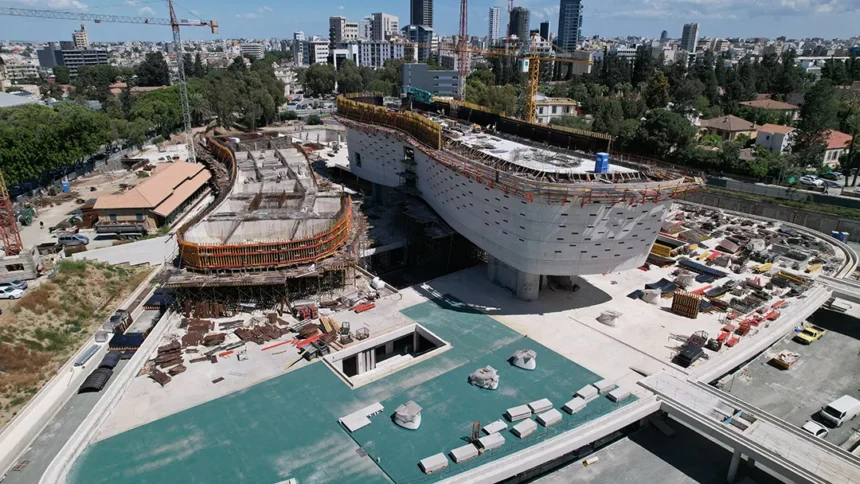
The Archaeological Museum of Cyprus is progressing towards its anticipated completion in 2027, following a one-year extension requested by the construction consortium. This highly complex project is noted for advancing more efficiently than other major public works on the island, with officials confirming that the delay will not result in extra costs.

Photo: en.philenews.com
Archaeological museum: Budget and Project Scale
The total cost of the museum is locked at €144 million, a figure that authorities assure will not increase despite the extended timeline. This museum represents the largest single-phase public project ever undertaken in Cyprus, and the extension is deemed reasonable given the intricate design and construction challenges involved.

Photo: en.philenews.com
Construction Complexity and Coordination
Officials have highlighted the extreme structural complexity of the museum’s design, which justifies the additional time needed for completion. The project is being executed by the Iacovou–Cyfield (M) Joint Venture, with architectural design by Theoni Xanthi of XZA Architects, the winner of the site’s international architectural competition.
A significant factor in the project’s progress has been the high level of coordination between various state departments and the construction consortium. This collaboration has enabled technical challenges to be addressed promptly, avoiding the typical pitfalls of public infrastructure projects in Cyprus.
Environmental Considerations and Innovative Features
The museum is being engineered with a near-zero environmental footprint, reflecting modern sustainability practices. It occupies a plot of 39,988 square metres, with a total built area of 30,000 square metres. The construction process requires substantial volumes of materials and specialised engineering components, ensuring that the building meets high standards of durability and functionality.
- Excavations & Concrete: 200,000 cubic metres of earthworks, 8,000 square metres of diaphragm walls, and 85,000 cubic metres of custom-treated grey and off-white concrete.
- Timber & Seismics: 1,000,000 unique timber pieces with varying geometries, and 77 custom-designed seismic isolators that allow displacement of up to 15 centimetres in any direction.
- Flooring: 10,000 square metres of handmade terrazzo flooring, 8,000 square metres of prefabricated plaza slabs, and 6,500 square metres of steam-bent curved wood flooring.
To protect the basement levels from extreme weather events, the museum will include four gravity-operated floodgates at its entrances. Furthermore, it will feature 17 high-tech elevators, a heavy freight platform, and 20 fire curtains designed to separate different zones for the safety of visitors and valuable artefacts.
Architectural Layout and Public Accessibility
The museum is designed with five levels, including two basement floors, a ground level, and a superstructure composed of three two-storey buildings. Its layout is divided into three primary operational zones:
- The Ground Zone: This area comprises the two basement levels and a sunken plaza on the first basement level. It will facilitate daily operations and features temporary exhibition galleries, educational spaces, conservation laboratories, administrative offices, a restaurant, a café, a gift shop, and parking facilities.
- The Upper Zone: This section consists of three elevated exhibition volumes, named “Topos” (Place), “Thalassa” (Sea), and “Kosmos” (World). These cantilevered structures raise the galleries above the ground level, enhancing the urban landscape.
- The Intermediate Zone: Designed as a civic plaza, this open public space will be filled with landscaped greenery, seating areas, and a glass-enclosed reception pavilion, promoting free public access and transforming the museum entrance into a central meeting point for the city.
Future Prospects for the Museum
The construction of the Archaeological Museum of Cyprus stands as a testament to innovative design and meticulous planning in public infrastructure. As the project moves closer to completion, it is expected to become a vital cultural hub, showcasing Cyprus’s rich heritage while adhering to modern sustainable practices. The combination of advanced engineering and thoughtful public space design is set to attract both locals and tourists, reinforcing the importance of cultural institutions in community engagement and education.