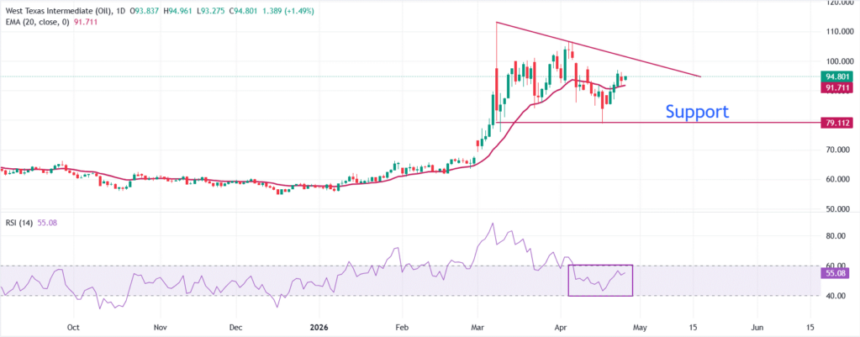
WTI crude oil prices are nearing the $95 mark, reflecting a 1.5% increase during the European trading session on Monday. The rise is largely attributed to the ongoing closure of the Strait of Hormuz, a key maritime passage that facilitates the transport of roughly 20% of the world’s oil supply. This critical situation is exacerbated by the stalled peace talks between the United States and Iran, which have seen diplomatic efforts hit a significant roadblock.
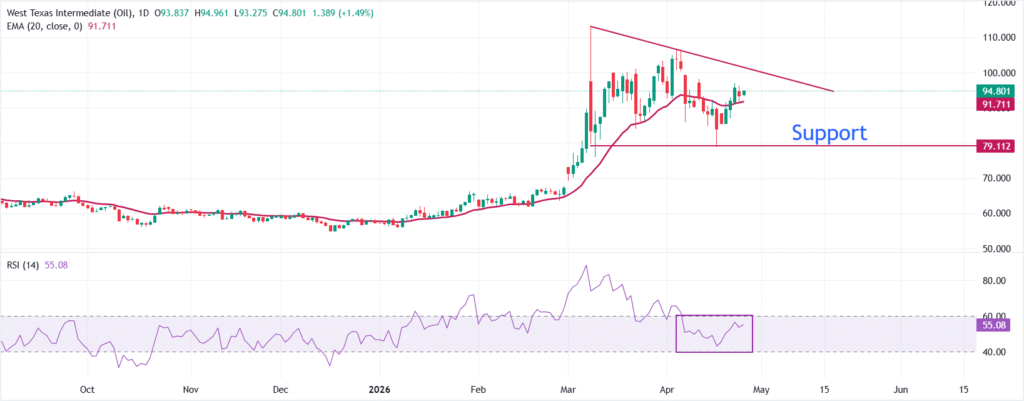
Photo: financialmirror.com
Reports indicate that the US has called off the planned visit of its envoys to Islamabad to meet with Iranian officials, a move President Donald Trump labelled as a waste of time. The US envoy’s absence from negotiations is particularly notable given the backdrop of Iran’s recent counteroffer, which was deemed unsatisfactory by Washington. Iranian Foreign Minister Seyed Abbas Araghchi’s proposal included the condition for lifting the US blockade on Iranian ports, a sticking point that complicates any potential agreements.
Potential for Further Price Increases
The stalled negotiations have left market analysts on high alert, with warnings that oil prices could see even further increases if the situation in the Strait of Hormuz remains unchanged. Under a bullish scenario outlined by OANDA, analysts project that if disruptions continue through to the end of June, Brent crude could spike to an astonishing $150 per barrel. As of noon on Monday, Brent was trading at approximately $101.30, reflecting a 2.2% gain.
Monitoring Central Bank Policies
As the oil market reacts to geopolitical tensions, investors are also gearing up for upcoming monetary policy announcements from several central banks this week. The Federal Reserve and the European Central Bank are particularly in focus, given their potential impact on the global economic landscape and, consequently, on oil demand.
Short-Term Price Dynamics for WTI
WTI spot prices currently exhibit a bullish bias, stabilising above the 20-day exponential moving average (EMA) at $91.71, which is crucial for maintaining the recent price rebound following last week’s pullback. On the upside, traders are eyeing the broken downward resistance trend line around the $100 mark, where renewed selling pressure may emerge if prices approach this threshold. Conversely, initial support is expected near the 20-day EMA at $91.71, with the key support area located at the April 17 low of $78.88.
With the ongoing uncertainty surrounding US-Iran relations and the implications for oil supply routes, traders will be closely watching price movements as geopolitical developments unfold. The interplay between diplomatic negotiations and market sentiment is likely to shape the price trajectory of crude oil in the near term.