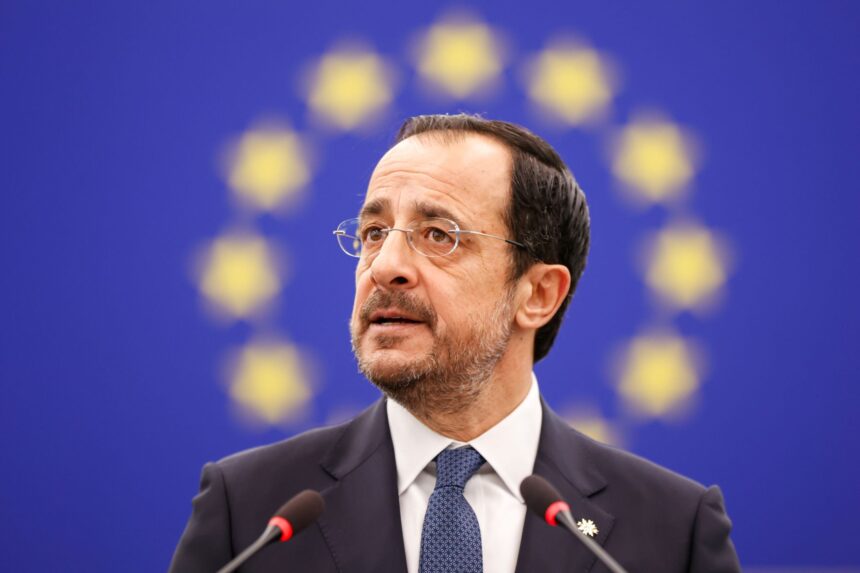
Unity is the European Union’s greatest strength, President Nikos Christodoulides emphasised during his address to the European Parliament on Tuesday. “Only by acting together, across institutions and across member states, can we translate unity into action,” he stated, outlining Cyprus’ priorities as it holds the EU Council presidency.

Photo: cyprus-mail.com
- The session concluded with a tête-à-tête between Christodoulides and Metsola, reinforcing the collaborative spirit needed as the EU navigates a rapidly evolving landscape.
In a speech delivered in Strasbourg, Christodoulides described the current moment as an inflection point for the EU, urging the need for a more autonomous Union that is both open to the world and capable of evolving. He reflected on the EU’s ability to adapt amid significant global challenges, highlighting crises in Ukraine, the Middle East, and climate change. “The international order we relied upon for decades is no longer a given,” he warned.
He identified five key pillars guiding Cyprus’ presidency: defence, competitiveness, enlargement, affordable housing, and budget. On the topic of Ukraine, he asserted the necessity of reaffirming the principle that force cannot redraw borders, stating, “If this principle fails, then everything becomes negotiable, whether in Ukraine, in Greenland, or anywhere else.” This urgency pointed towards the need for a stronger European security architecture.
Roberta Metsola, President of the European Parliament, welcomed Christodoulides, pledging ongoing support for Cyprus. She reiterated that the challenges faced by Cyprus are shared European issues and expressed gratitude for Christodoulides’ leadership during a complex period. “We are grateful to have you at the helm as Europe navigates what may come,” she noted.
During a subsequent debate, Christodoulides responded to various interventions by Members of the European Parliament (MEPs). He highlighted that European integration hinges on the resolution of the Turkish occupation of part of Cyprus and pointed to Cyprus’ significant progress in managing immigration. He reported an 80 per cent drop in arrivals and a 60 per cent increase in returns, underscoring the nation’s commitment to finding effective solutions.
Joining the Schengen area emerged as a strategic aim for Cyprus, with the country having successfully passed all technical evaluations and now awaiting the European Commission’s final report. This move is seen as integral to Cyprus’s future within the EU framework.
In addition to immigration, Christodoulides outlined plans for a series of EU policies aimed at enhancing stability in the broader Middle East region during Cyprus’ presidency. He underscored the importance of transparency and accountability, noting that Cyprus has attracted significant foreign investment due to positive ratings in international reports.
The economic indicators reflect this success, with growth surpassing 3 per cent, unemployment rates dropping below 5 per cent for the first time since 2008, and public debt stabilised around 50 per cent. These developments have paved the way for further investments in social policies.
On the topic of the EU budget, Christodoulides called for a multiannual financial framework that adequately meets all needs while maintaining beneficial policies like the cohesion fund and the common agricultural policy. His approach reflects a commitment to ensuring that the EU budget supports the well-being of its citizens.
The session concluded with a tête-à-tête between Christodoulides and Metsola, reinforcing the collaborative spirit needed as the EU navigates a rapidly evolving landscape.