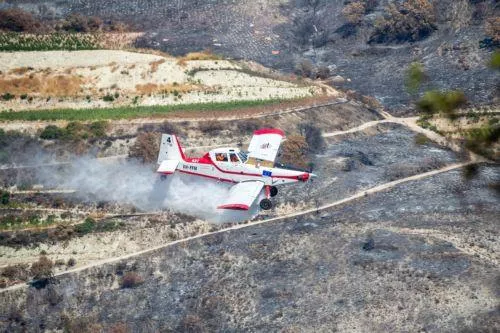
firefighting aircraft — The tendering process for the acquisition of three firefighting aircraft is currently underway in Cyprus, as the government aims to bolster its aerial firefighting capabilities. One of these aircraft will be funded through the Recovery and Resilience Plan, according to Andreas Grigoriou, Director General of the Ministry of Agriculture, Rural Development, and Environment.
Grigoriou announced the tender during a statement to the Cyprus News Agency (CNA) on Friday, revealing that it is part of a larger initiative to procure a total of ten proprietary aerial firefighting assets over the next five years, with the possibility of acquiring an additional five aircraft in the future.
Firefighting aircraft: Current Aerial Resources and Fire Season Preparedness
As the current fire season progresses, Cyprus has 13 primary aerial firefighting assets at its disposal, consisting of nine aeroplanes and four helicopters. In addition, helicopters from the National Guard and the Police are on standby as secondary support resources, ready to assist in firefighting efforts.
Technological Advancements in Fire Management
In addressing the need for improved technology, Grigoriou outlined a comprehensive plan aimed at enhancing the surveillance system for forested areas. This initiative focuses on early fire detection and the efficient transmission of images to Operational Centres. He noted that Phase A of this plan has already been completed, which includes the establishment of a basic wireless data transfer network and the pilot installation of four fire detection sensors in key forested regions, alongside the acquisition of five drone systems.
Looking ahead, Phase B of the programme will introduce further enhancements. This includes the installation of 15 additional electro-optical systems designed for automated fire detection, specialised software for risk forecasting and fire evolution simulation, and the procurement of two observation balloon trailers. Moreover, three mobile operational centres will be introduced, and existing drone systems will be upgraded.
Communication Improvements Among Firefighting Services
Grigoriou also highlighted the introduction of the TETRA telecommunication system, which has been implemented for the Department of Forests since the onset of this year’s high-risk fire period. He remarked, “This specific system will significantly improve internal communication both among the Department of Forests’ personnel and, crucially, among the Services involved in fire management.”
Strengthening Ground Firefighting Assets Amid Climate Challenges
In recent years, the Department of Forests has significantly enhanced its ground firefighting assets. Through the Recovery and Resilience Plan, Cyprus has acquired various resources, including 25 special-purpose and all-terrain firefighting vehicles with a two-tonne water capacity, eight tracked earth movers, and additional vehicles for transporting personnel and equipment.
Grigoriou revealed that by 2026, the Department of Forests is set to receive 17 large firefighting vehicles capable of carrying six tonnes of water, with 12 of these funded through the Recovery and Resilience Plan. Furthermore, the department has recently received two truck/platforms for transporting earth movers and ten rapid intervention firefighting vehicles.
The Impact of Climate Change on Fire Incidence
Discussing the broader environmental context, Grigoriou acknowledged the adverse effects of climate change on Cyprus, where rising temperatures and declining rainfall are becoming the norm. “Unfortunately, the climate change observed in every corner of the planet is also affecting Cyprus, with temperatures recording an upward trend and rainfall declining,” he noted.
He warned that these changes are influencing fire behaviour, leading to more frequent and intense fire incidents. The combination of challenging weather conditions, the abandonment of rural areas, and changing land use patterns exacerbate the difficulties faced during fire seasons.