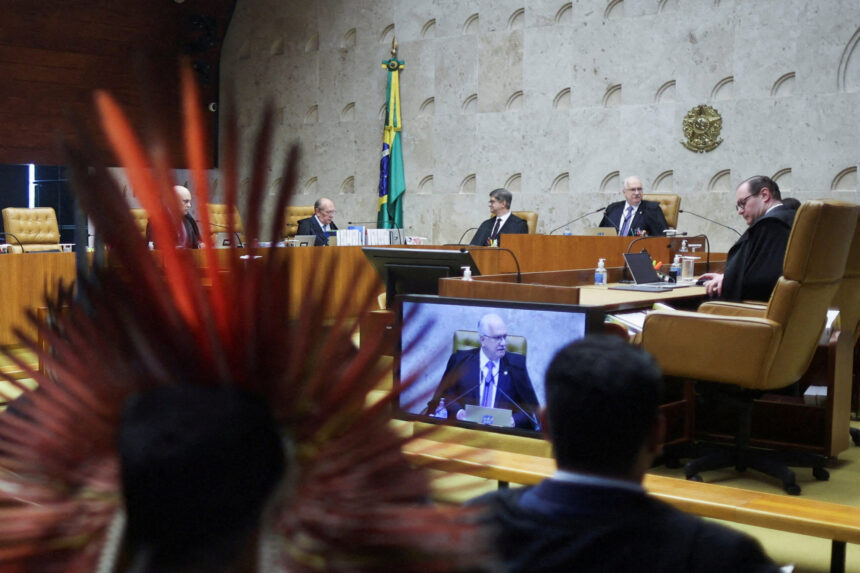
Brazil’s Supreme Court has reaffirmed Indigenous land rights, a decision that underscores the ongoing tension between the judiciary and Congress. In a ruling delivered on Wednesday, six of the ten Supreme Court judges voted to entrench Indigenous land rights as inviolable clauses within Brazil’s constitution, effectively curbing legislative attempts to limit these recognitions. This landmark ruling highlights the judiciary’s role in protecting historically marginalised communities amidst increasing resistance from a powerful agricultural lobby.
Judicial Authority vs Legislative Intent
The Supreme Court’s decision sends a clear message to lawmakers who have sought to amend constitutional protections for Indigenous peoples. Deborah Duprat, a former federal prosecutor with extensive experience in Indigenous rights, remarked, “It’s an important message to Congress.” While four justices have yet to publicly express their opinions, their votes would not have sufficed to overturn the majority’s stance.
Historical Context of Indigenous Land Rights
Brazil’s constitution, established in 1988, acknowledges the rights of Indigenous communities to their ancestral territories. However, the actual demarcation of these lands has been a protracted process, leaving many communities in a state of limbo. Advocates argue that hundreds of Indigenous groups are still waiting for formal recognition of their territories, often finding themselves embroiled in violent disputes over land.
Legislative Challenges to Indigenous Rights
In recent years, a robust agricultural lobby, supported by a conservative majority in Congress, has intensified efforts to challenge Indigenous land claims. In 2023, lawmakers passed legislation aimed at limiting protections for Indigenous lands, stipulating that communities could only claim land they can prove to have occupied since the constitution’s enactment. Proponents of this law argue that it safeguards landowners from unforeseen claims that may arise from historical occupancy.
As the Supreme Court prepared to evaluate the constitutionality of this law, the Senate took steps to amend the constitution to align with the 2023 legislation. The lower house of Congress is also poised to pass this constitutional amendment, which could further complicate the situation for Indigenous communities.
Supreme Court Justices’ Stance
Despite the legislative push, several justices on the Supreme Court have articulated their belief that such amendments to the constitution are impermissible due to their fundamental nature. Justice Flavio Dino asserted that “the legislative branch may not, under any pretext, suppress or reduce rights guaranteed to Indigenous peoples, under penalty of violating the foundational principles of the democratic rule of law.” This assertion reinforces the judiciary’s commitment to upholding the rights of Indigenous groups amid growing legislative encroachment.
Implications for Indigenous Communities
The Supreme Court’s ruling is likely to have far-reaching implications for Indigenous communities across Brazil. With a significant number of groups still awaiting land recognition, the decision could serve as a pivotal moment in the long-standing struggle for Indigenous rights. Advocates argue that this ruling may not only protect existing territories but also pave the way for more robust recognition of unrecognised lands.
However, the ruling also risks exacerbating tensions between the judiciary and Congress. With the legislative body pushing for amendments, the potential for conflict remains high. Lawmakers may continue to pursue pathways to weaken protections for Indigenous rights, which could lead to further legal battles in the Supreme Court.
Public and Political Reactions
The reaction to the Supreme Court’s ruling has been mixed among the public and political factions. Indigenous rights advocates have lauded the decision as a crucial victory, while some members of Congress have expressed frustration at what they perceive as judicial overreach. This division highlights the broader societal debate regarding the balance of power between different branches of government and the rights of historically marginalised populations.
As the nation grapples with these issues, it is clear that the path forward will be fraught with challenges. The Supreme Court’s ruling serves as both a beacon of hope for Indigenous communities and a flashpoint in the ongoing struggle between legislative authority and judicial protection.
The Road Ahead
Moving forward, the landscape for Indigenous rights in Brazil will likely continue to evolve. As lawmakers seek to assert their authority over land rights, the Supreme Court’s willingness to defend these rights will be tested. The interplay between judicial rulings and legislative actions will shape the future of Indigenous land claims and the broader discourse on social justice in Brazil.
Ultimately, the Supreme Court’s recent ruling reaffirms the crucial role that judicial oversight plays in safeguarding the rights of vulnerable communities. While the road to full recognition and protection of Indigenous lands remains long, this decision marks a significant step in the ongoing journey toward justice for Indigenous peoples in Brazil.