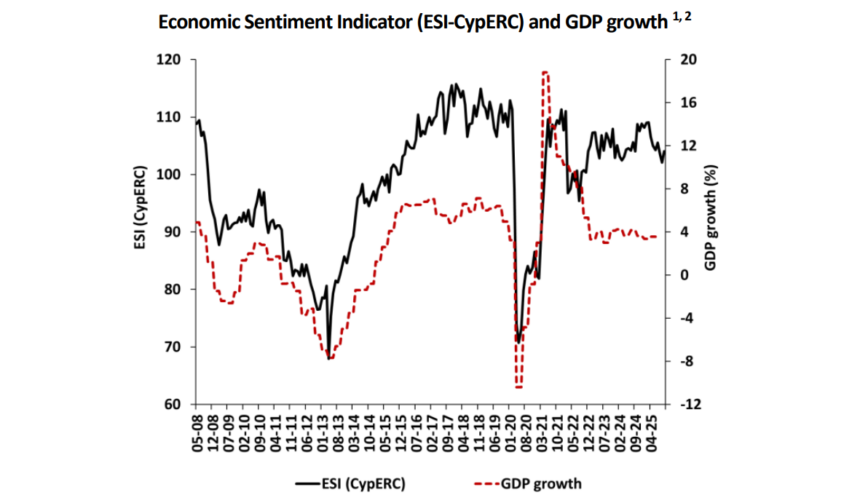
Economic sentiment in Cyprus recovered in October, as the Economic Sentiment Indicator (ESI-CypERC) rose by 2.0 points, following a decline in September to 102.1 from 103.7 in August. This uptick indicates a strengthening confidence among businesses, particularly in the services and construction sectors.

Photo: financialmirror.com
The Economics Research Centre of the University of Cyprus reported that the rise in the overall ESI was largely driven by improved business confidence. After experiencing significant declines in the previous two months, the services sector showed notable resilience. The Services Confidence Indicator, which reflects the sentiments of businesses within this sector, increased as all its components, including assessments of recent business situations and expected turnover, improved.
In contrast, the Retail Trade Confidence Indicator saw a decrease, influenced primarily by a decline in firms’ perceptions regarding recent sales and stock volumes. Additionally, businesses revised their sales expectations downwards, signalling cautiousness in consumer demand.
Meanwhile, the Construction Confidence Indicator recorded an increase, supported by better order book levels and optimistic revisions in employment expectations. This suggests that construction firms are beginning to anticipate more robust activity in the months ahead.
On a different note, the Industry Confidence Indicator experienced a slight decline. This was attributed to less favourable evaluations of current order levels and downward revisions in production expectations, indicating some sector-specific challenges still persist.
The Consumer Confidence Indicator also fell in October, reversing the positive trend of the previous two months. Consumers reported a deterioration in their financial situations and exhibited weaker intentions to make significant purchases. Furthermore, expectations regarding the general economic conditions in Cyprus declined, reflecting growing apprehension among households.
Despite these mixed signals, the Economic Uncertainty Indicator decreased to 11.7 points from 15.8 in September. The drop was primarily due to a reduction in business uncertainty across most sectors, with the exception of industry, where some uncertainty increased slightly. While consumer uncertainty rose, it remained low across various income groups, suggesting that while concerns exist, they are not pervasive.
As the economy navigates these fluctuations in sentiment, the implications for investment and broader economic strategies will be closely monitored. Stakeholders are likely to keep an eye on the evolving landscape, particularly how consumer behaviour and business confidence will influence recovery trajectories in the coming months.