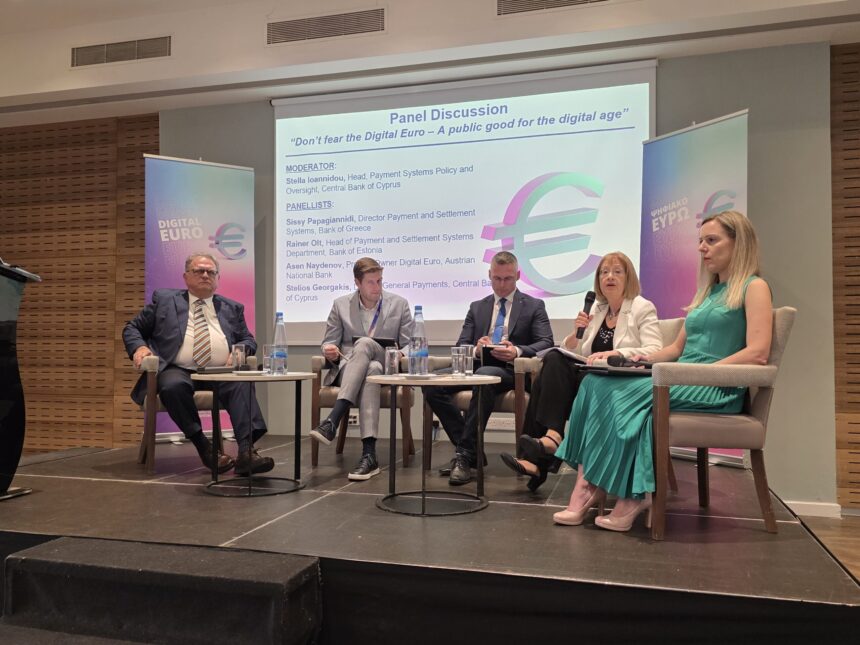
The Central Bank of Cyprus (CBC) convened its inaugural session on the digital euro, gathering key payment service providers as discussions intensify ahead of a crucial decision from the European Central Bank (ECB).

Photo: cyprus-mail.com
- He emphasised that this framework will align with the legislative provisions currently under discussion in Brussels, serving as the backbone for the digital euro’s operational structure.
- He further explained that the organisation of digital euro services, including access, liquidity, and transaction management, would be structured to uphold safety, interoperability, and resilience.
- The consensus was that these factors hold not just technical significance but also strategic importance for Europe’s future financial landscape.
Key Meeting Highlights the Digital Euro’s Importance
This pivotal gathering included representatives from banks, payment institutions, and electronic money institutions. The session was held on Friday and aimed to address the ongoing legislative negotiations in Brussels regarding the Single Currency Package.

Photo: cyprus-mail.com
Governor’s Call for Enhanced Resilience
In his opening address, delivered by executive director George Karatzias on behalf of CBC governor Christodoulos Patsalides, the urgency of the meeting was underscored. Karatzias noted that the discussions are taking place at a “decisive moment” as preparations for the digital euro advance towards a key milestone.
The governor expressed a significant concern: Cyprus’ heavy reliance on non-European payment providers. He urged payment service providers to engage with the forthcoming “Digital Euro Rulebook” and to consider the implications for their digitalisation efforts, innovation, and business models.
Encouraging Participation in Experimental Activities
Patsalides further encouraged the financial sector in Cyprus to actively participate in the second round of experimental activities on the ECB’s innovation platform. This initiative aims to enhance the understanding and applicability of the digital euro among local financial entities.
Insights on the Digital Euro Project’s Progress
During the session, CBC’s Director General of Payments, Stelios Georgakis, and Head of the Payment Systems Policy and Oversight Division, Stella Ioannidou, presented updates on the digital euro project. They shared expectations for upcoming decisions and outlined how these developments would impact payment service providers as potential distributors and receivers of the digital euro.
One of their central messages highlighted the importance of leveraging the digital euro platform to ensure that private payment solutions developed in Cyprus can achieve a broader, pan-European reach.
Establishing Unified Standards for Digital Euro Payments
A standout feature of the session was a presentation by Patrick Papsdorf, Director for Rulebook Development at the European Central Bank. Papsdorf elaborated on the creation of a unified set of standards, processes, and rules that will govern digital euro payments across the euro area.
He emphasised that this framework will align with the legislative provisions currently under discussion in Brussels, serving as the backbone for the digital euro’s operational structure.
Framework Flexibility and Compliance
Papsdorf provided insight into the work of the ECB’s Rulebook Development Group, detailing how payment service providers would be integrated into the digital euro scheme. He elaborated on eligibility criteria, the enrolment process, obligations, and conditions under which services could be terminated or suspended.
He also stated that a revised draft of the Rulebook had been submitted to the development group, adding that the document is designed to be flexible enough to adapt to any legislative changes that might arise during ongoing discussions regarding digital euro regulation.
Enhancing User Experience Across the Euro Area
Participants were shown drafts relating to minimum user experience standards, illustrative usage scenarios, and comprehensive process flows. Papsdorf stressed the importance of adhering to the rulebook, asserting that “compliance will ensure a standardised, secure, and high-quality user experience for all involved,” while fostering innovation and competition throughout the euro area.
He further explained that the organisation of digital euro services, including access, liquidity, and transaction management, would be structured to uphold safety, interoperability, and resilience.
Strategic Discussions on Adoption Readiness
A roundtable discussion followed the presentations, featuring senior officials from central banks in Greece, Estonia, Austria, and Cyprus. Participants, including Sissy Papagiannidou, Rainer Olt, Asen Naydenov, and Stelios Georgakis, deliberated on critical aspects such as cost, network effects, risk assessment, and market readiness for the digital euro’s adoption.
The consensus was that these factors hold not just technical significance but also strategic importance for Europe’s future financial landscape.
Engaging with Experts and Future Directions
As the session concluded, attendees were given the opportunity to ask clarifying questions and exchange insights with the experts present. This engagement allowed for deeper understanding and collaboration among various stakeholders involved in the digital euro initiative.
The digital euro discussions in Cyprus mark a significant step in the EU’s financial evolution, as the region prepares for a future where digital currencies could reshape the landscape of payment systems.