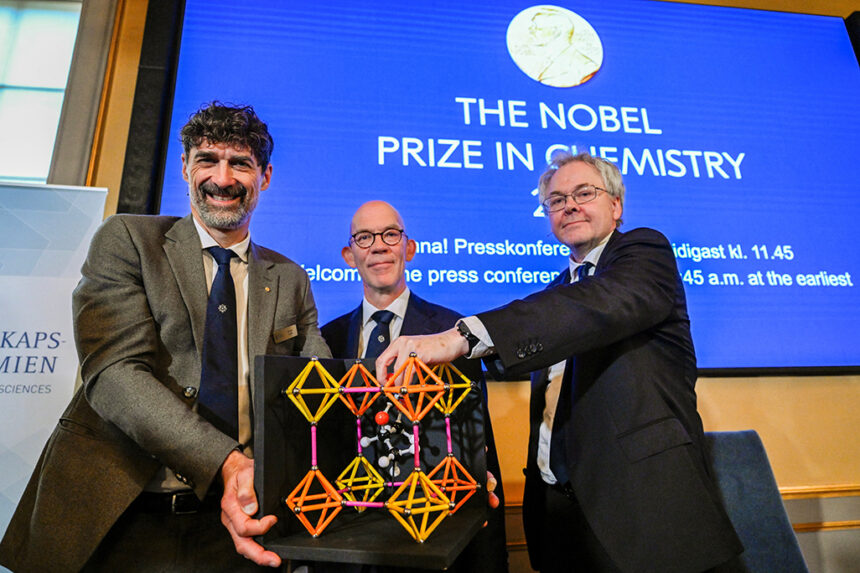
hermione s — hermione s — Scientists Susumu Kitagawa, Richard Robson, and Omar Yaghi have been awarded the 2025 Nobel Chemistry Prize for their groundbreaking work in developing a new form of molecular architecture, famously likened to ‘Hermione’s handbag’ from Harry Potter.
The laureates created innovative molecular constructions known as metal-organic frameworks (MOFs) that offer vast possibilities in addressing pressing global issues such as climate change and the scarcity of fresh water. These frameworks are designed with large spaces that allow gases and chemicals to flow through, making them suitable for various applications including harvesting water from arid environments and capturing harmful carbon dioxide.
The Royal Swedish Academy of Sciences highlighted the extraordinary properties of these materials, noting that a piece the size of a small sugar cube could possess the same surface area as a large football pitch. Olof Ramstrom, a member of the Nobel Committee for Chemistry, remarked, “A small amount of such material can be almost like Hermione’s handbag in Harry Potter. It can store huge amounts of gas in a tiny volume.”
In a press conference following the announcement, Kitagawa expressed his gratitude, saying, “My dream is to capture air and separate air to – for instance, in CO2 or oxygen or water or something – and convert this to useful materials using renewable energy.” His vision underscores the potential of MOFs to revolutionise how we interact with our environment.
The significance of their discoveries extends beyond initial applications. Chemists have since developed tens of thousands of different MOFs, some of which may help tackle significant challenges facing humanity. The Academy also pointed out that these materials could be instrumental in separating toxic per- and polyfluoroalkyl substances (PFAS), often referred to as ‘forever chemicals’, from water and breaking down trace pharmaceuticals in the environment.
Kitagawa, a professor at Kyoto University in Japan, Robson, a professor at the University of Melbourne in Australia, and Yaghi, a professor at the University of California, Berkeley, all bring diverse backgrounds to their collaboration. Yaghi, whose family has roots in Palestine, noted that his team’s work on creating a robust, durable, and highly porous crystal-like structure using metal atoms sparked significant developments in the field.
This year’s Chemistry Nobel marks the third award announced in the 2025 series, following the prizes for medicine and physics earlier in the week. Established by Alfred Nobel’s will, these prestigious awards have been recognising excellence in science, literature, and peace since 1901, albeit with some interruptions due to global conflicts.
The chemistry prize often highlights remarkable discoveries that may not receive as much attention as those in the domains of physics or literature. Yet, it has celebrated many pivotal advancements, including the developments of nuclear fission and DNA sequencing techniques. Last year, the award recognised the contributions of U.S. scientists David Baker and John Jumper alongside Briton Demis Hassabis for their work in protein structure decoding, which has significant implications for drug development.